LogoLogoGaN Servo
Start inquiry
LogoLogoGaN Servo
WhatsApp
LogoLogoGaN Servo

Micro GaN servo PCBA and robotic joint servo OEM manufacturing from prototype to mass production.

Inquiry Email

[email protected]

Email app

Include target torque/speed, quantity, and delivery location.

Instant Chat

+8618857971991

Chat on WhatsApp

Direct response from our engineering team.

Products
  • Micro GaN Servo PCBA
  • Robotic Joint Servo OEM
  • Low Voltage GaN Module
  • Driver-Encoder Stack
  • 48 V Bare-Board Driver
  • Ring-Shaped Joint PCBA
  • Micro GaN Surgical Drive
  • High-Frequency UAV GaN ESC
Solutions
  • Humanoid Micro Actuators
  • Drone and eVTOL Servo Control
  • Medical Robotic Arms
  • Precision Grippers
OEM Capabilities
  • OEM Manufacturing
  • SMT PCBA Assembly
  • Firmware and Control Loop
  • Robot Joint BOM Turnkey
  • Prototype to Mass Production
Resources
  • Blog
  • About
  • Contact / RFQ
  • Quality Facilities
  • STEP Envelope Guide
  • Privacy Policy
  • Cookie Policy
  • Terms of Service
© 2026 GaN Servo. All Rights Reserved.|Backed by Linkup Ai Co., Ltd. Manufacturing delivered by the Advanced Manufacturing Division of Linkup Precision.
← Back to Products24V Tool First + RFQ Report

24V Compact Actuator Driver Board

Run a first-pass 24V board feasibility check, then use the report layer to decide whether the compact GaN PCBA path is ready for an OEM RFQ.

Run Board Sizer Send RFQ Inputs

Published July 24, 2026 | Last updated July 24, 2026

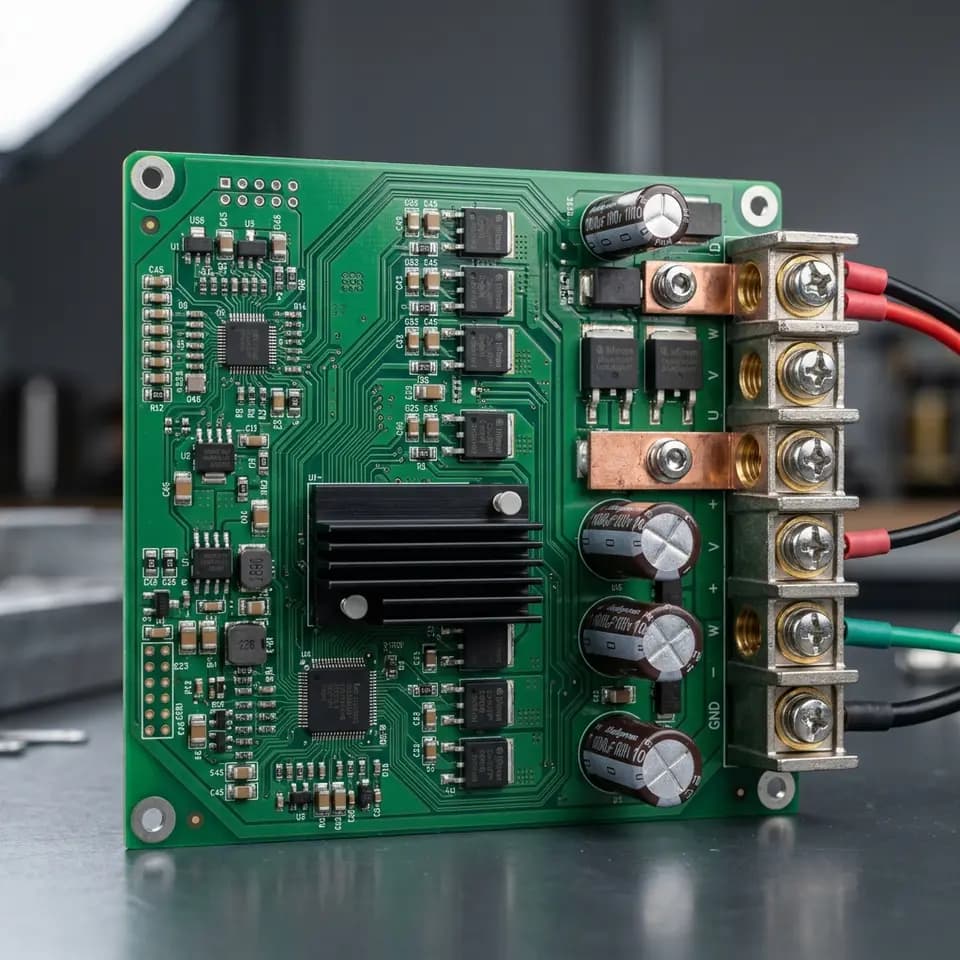
24V compact actuator driver board PCBA modules arranged beside a ring actuator
Product visual for board envelope, connector, and actuator integration planning.
24V Micro GaN Board Sizer
Use this as first-pass RFQ triage for compact actuator driver boards before thermal simulation and motor characterization.
24V

This calculator is intentionally scoped to 24V compact actuator driver boards. Use a separate architecture review for 12V, 48V, or 60V drives.

10 A

Range: 1A to 35A RMS. Values above 28A are automatically treated as high-risk at 24V.

25 A

Peak current must be at least the RMS value; below 1.5x RMS the result is flagged for torque-headroom review.

Awaiting 24V actuator constraints

Set current, burst demand, envelope, and thermal path to view the RFQ feasibility state.


Report Layer

Decision Summary for 24V Compact Boards

The report is scoped to the same 24V actuator-board intent as the tool. It explains when GaN helps, what still limits the design, and which evidence should be checked before requesting a production quote.

24V

Fixed Bus Assumption

Use 24V when the battery, safety, and actuator envelope matter more than maximum power density. Above ~500W continuous, compare a higher bus before locking the layout.

50-100kHz

Reference-Class PWM Target

GaN can support higher switching-frequency targets than conventional low-voltage silicon designs, but EMI, current sensing, and firmware must be validated together.

RFQ

Output Is a Triage Path

The calculator estimates feasibility, not production release. It should trigger thermal modeling, layout review, and motor current-limit validation.

Best-Fit Use Cases

  • Medical and Lab Mechatronics:

    24V bus preference, low acoustic signature, and compact motor housings where serviceability matters.

  • Dexterous Hands and Wrist Joints:

    Hollow-shaft or small rectangular PCBAs where every connector, sensor, and thermal via must be co-designed.

  • Lightweight UAV Gimbals:

    Short burst loads where airflow or metal housing contact can provide a credible thermal path.

Poor-Fit Conditions

  • Heavy Payload Legs Above ~500W:

    High-torque knee or hip joints often need 48V or 60V to reduce current density, cable loss, and copper heating.

  • Sealed Plastic Enclosures:

    A compact GaN package still needs a heat path. No metal conduction path usually means a larger board or lower RMS current.

  • Cost-Only Industrial Drives:

    If space, weight, and acoustic output are not constraints, commodity silicon or AC drive platforms may be a better purchasing decision.

Silicon vs GaN Architecture at 24V

Decision FactorTraditional Si MOSFET PathCompact GaN PathWhat to Validate
PWM Frequency20kHz-class designs are common when acoustic noise and switching loss must be balanced.50-100kHz-class operation is plausible in vendor reference designs when layout and gate-drive discipline are strong.Current ripple, torque ripple, switching temperature, EMI, and controller sampling margin.
Dead-Time LossLonger dead-time budgets are often used to protect discrete half-bridges.Integrated GaN stages can support shorter or adaptive dead-time strategies, but the exact target is device-specific.Shoot-through margin, bootstrap behavior, firmware timing, and transient ringing.
Reverse-Recovery BehaviorBody-diode recovery can add loss and switching-node stress.Lateral GaN avoids the MOSFET body-diode reverse-recovery mechanism, reducing one major ringing contributor.Power-loop inductance, snubber need, encoder coupling, and measured switch-node waveform.
Board AreaLarger passive, copper, and thermal mass budgets are often needed when switching frequency is lower.Smaller power-stage packages and higher frequency can reduce passive volume, but connectors and sensors can dominate the outline.Connector exit, current shunt or magnetic sensor, encoder keep-out, thermal vias, and assembly access.
Efficiency ClaimUse measured silicon reference losses for the same motor and duty cycle.Expect an application-dependent gain, not a universal percentage.Compare conduction, switching, dead-time, and control-loop losses on the same load profile.

Visualizing the Thermal Trade-Off

Si pathlarger lossPassive + copper budgetGaNcompactHousing heat path

Compact does not mean thermally free

GaN can move the design toward a smaller power stage and smaller passive budget, but heat becomes concentrated. The decisive question is whether the actuator housing can carry that heat away without disturbing the encoder, strain relief, or user-facing surface temperature.

Illustration only; no temperature or board-area value in this diagram should be read as a measured result.

Evidence, Assumptions, and Limits

Source review date: July 24, 2026. Claims below are used as RFQ inputs, not final production specifications.

Calculator Assumptions

  • Nominal 24V DC bus with actuator-local power stage.
  • RMS current is treated as the thermal driver; 2s peak current is treated as burst-headroom stress.
  • Board-area output is a planning estimate and must be replaced by actual layout, copper, via, and enclosure data.

Production Validation Gates

  • Thermal simulation plus instrumented prototype testing at realistic duty cycle.
  • Switch-node waveform, EMI scan, encoder noise, and firmware dead-time verification.
  • Supplier-specific FET, driver, capacitor, and current-sense derating.
Traceable SourceSupportsLimit
EPC low-voltage BLDC motor-drive application noteLow-voltage GaN inverter layout, compact motor-drive reference architecture, and thermal protection considerations.Reference-design conditions only; it is not a measured GanServo actuator-board guarantee.
TI 24V-60V GaN inverter reference design guideA documented GaN inverter reference design in the low-voltage robotics motor-drive range.Reference design scale and power level differ from an ultra-compact actuator board.
TI GaN gate-driver basicsGaN driver selection, layout discipline, and reduced form-factor design guidance.Training material is topology-level guidance, not a 24V actuator certification.
TI three-phase motor-drive current-sensing articleCurrent-sense placement and control-loop considerations for precision three-phase motor drives.Current-sensing guidance does not replace board-specific EMI and thermal testing.

Risk Matrix Before RFQ

Thermal Overconfidence

A smaller GaN package can hide a hotter local junction. Ask for housing temperature rise, junction estimate, and thermal camera data on the same duty cycle.

EMI Near Encoders

Faster edges can reduce losses while increasing coupling risk. Keep encoder routing, ground strategy, and snubber options visible in the first layout review.

Architecture Mismatch

24V may be the wrong answer for sustained high torque. Compare 48V or 60V when current, cable gauge, or battery sag dominates the design.

RFQ Package and Internal Routing

Keep the 24V board request focused: send motor constants, RMS/peak current, target outline, thermal path, encoder interface, duty cycle, and battery tolerance. Use the adjacent pages below only when the architecture changes.

Send 24V Board RFQ Compare Micro GaN Servo PCBAReview Low-Voltage GaN ModuleCheck Step Envelope Guide

Frequently Asked Questions

Why is this page scoped to 24V compact actuator driver boards?

The calculator assumes a 24V nominal DC bus because the keyword intent is about compact actuator driver boards, not general 12V, 48V, or 60V servo drives. At 24V, current density and thermal routing dominate the decision, so the tool keeps that architecture fixed.

When should a team move from 24V to 48V or 60V?

When continuous electrical power rises above roughly 500W, cable and copper losses become the limiting factor for many compact joints. A 48V bus halves current for the same power and can reduce I2R wiring loss by about 4x, but it changes battery, isolation, and safety decisions.

Can GaN guarantee a sub-30mm actuator board?

No. GaN can shrink the power-stage and passive budget, but connector exits, current sensors, encoders, creepage, EMI filters, and thermal vias often decide the final board outline. Treat sub-30mm packaging as feasible only after layout and thermal review.

What inputs are needed for an OEM RFQ?

Send the motor winding resistance, Kv or torque constant, RMS and burst current, duty cycle, target board outline, enclosure material, allowable housing temperature rise, encoder interface, and planned battery bus tolerance.

Is the calculator a production design rule?

No. It is a first-pass triage tool. Production release still requires schematic review, layout review, thermal simulation, instrumented prototype testing, EMI validation, firmware current-limit validation, and supplier-specific component derating.

Why does thermal path matter as much as current?

A compact GaN stage can concentrate heat in a small package. Direct conduction into an actuator housing may be workable, while sealed plastic enclosures often need a larger board, lower RMS current, or a different bus voltage.

Inquiry Email

[email protected]

Email app

Include target torque/speed, quantity, and delivery location.

Instant Chat

+8618857971991

Chat on WhatsApp

Direct response from our engineering team.