

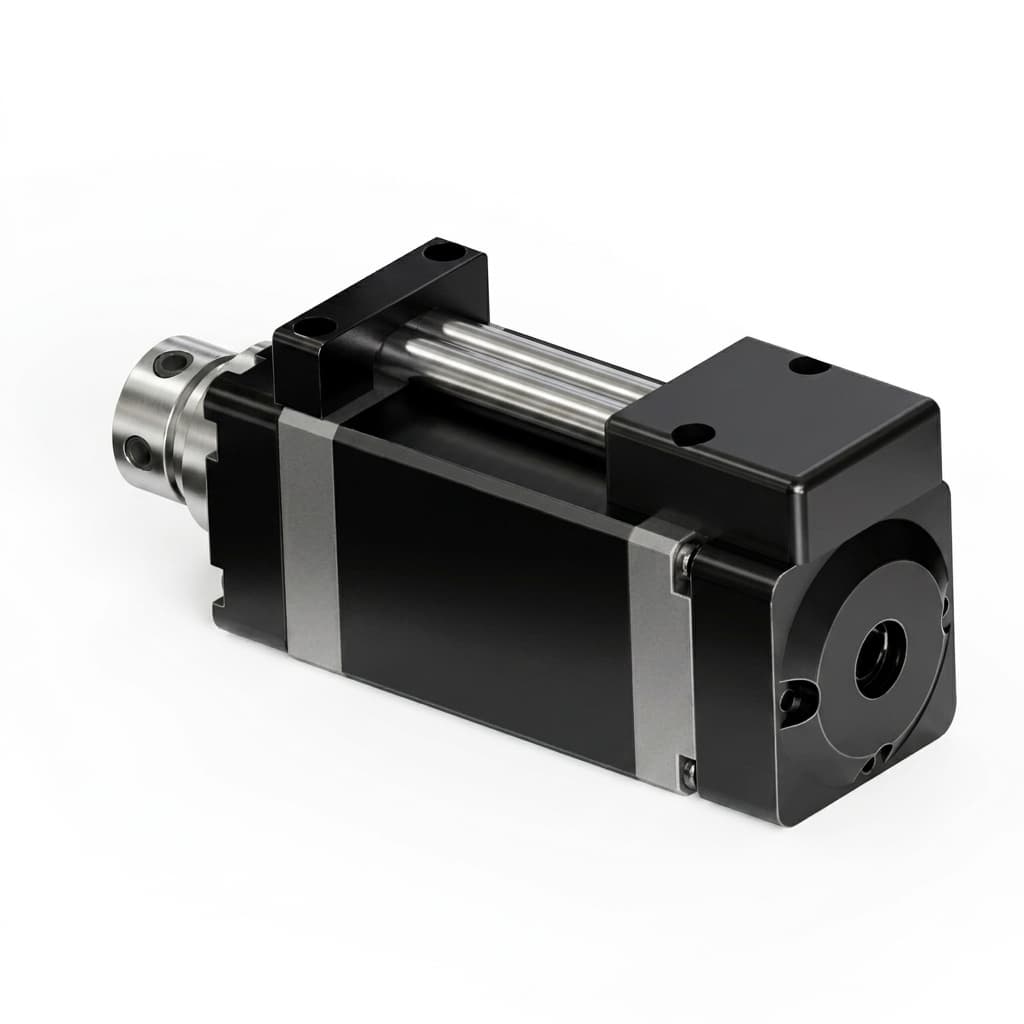
48V GaN Servo Architecture for Humanoid and AMR Procurement
See why 48V GaN servo drives help humanoid and AMR teams cut harness weight, manage heat, vet suppliers, and request a 48V evaluation kit for pilot sourcing.
For procurement teams, hardware architects, and system integrators designing the next generation of Autonomous Mobile Robots (AMRs), Automated Guided Vehicles (AGVs), and bipedal humanoid platforms, the transition from traditional 24V architectures to 48V DC battery systems represents a generational leap in system engineering. While increasing the bus voltage solves critical challenges related to cabling weight and power distribution, it introduces an immediate bottleneck at the joint level: traditional silicon (Si) MOSFET motor drives struggle to handle 48V efficiently within the severe spatial constraints of modern robotic actuators.
The solution driving the current procurement cycle is the rapid commercialization of Gallium Nitride (GaN) wide-bandgap semiconductors. GaN is not merely an incremental component upgrade; it is a foundational technology that allows engineering teams to fully unlock the benefits of a 48V architecture without paying the penalty of massive heatsinks or bulky joint housings.
Executive Summary (TL;DR)
- The shift to 48V architectures in robotics is driven by the need to halve cabling weight and reduce I²R power losses, which is critical for humanoids and heavy-payload AMRs.
- Traditional silicon drives at 48V generate excessive switching losses in high-frequency applications, requiring bulky aluminum heatsinks that ruin the weight savings of the 48V transition.
- Gallium Nitride (GaN) micro servos operate at >100kHz frequencies with near-zero reverse recovery losses, allowing them to handle 48V efficiently in extremely compact, heatsink-free form factors.
- Procurement teams must evaluate GaN servo suppliers based on high-frequency PCB layout expertise, firmware dead-time management, and EMI shielding capabilities.
Report Scope & Update (July 2026): This in-depth analysis is tailored for B2B procurement managers, supply chain directors, and lead robotics engineers navigating the transition to 48V battery systems. The models discussed apply to low-voltage, high-dynamic-response joint actuators, drone gimbals, and mobile logistics robots. It does not apply to stationary, line-voltage (480V AC) industrial robotic arms.
Need a quick RFQ go/no-go before the next actuator review? Compare your bus-voltage and envelope targets against the 48V bare-board GaN servo driver, or send the motor and joint envelope for a 48V evaluation-kit discussion.
In this comprehensive report, we will analyze the physical imperatives of the 48V transition, the failure of legacy silicon at this new standard, the strategic value of GaN technology, and the strict validation criteria procurement teams must enforce when sourcing next-generation micro servo drives.
1. The 48V Mandate: The Physics of Wiring and Weight
Historically, 24V DC has been the gold standard for mobile robotics and warehouse automation. It is safe, components are highly commoditized, and it provides sufficient power for lightweight tasks. However, as the industry pivots toward bipedal humanoids (which require highly explosive, high-torque joint movements) and heavy-duty AMRs carrying multi-ton payloads, 24V has hit a physical wall.
The core issue is Ohm’s Law and Joule heating ($P = I^2R$). To deliver 1000 Watts of power to a robotic joint at 24V, the system must push approximately 41.6 Amps of continuous current through the robot's wiring harness. Managing 41.6 Amps requires thick, heavy copper cables. In a multi-axis humanoid with 30 to 40 degrees of freedom, the wiring harness alone can add kilograms of dead weight to the structure.
By transitioning the battery pack and DC bus to 48V, the current required to deliver that same 1000 Watts is cut in half, down to 20.8 Amps.
For procurement and system engineers, halving the current yields three massive system-level advantages:
- Copper Weight Reduction: Engineers can specify significantly thinner wire gauges (e.g., dropping from 10 AWG to 14 AWG), drastically reducing the weight of the robot's nervous system.
- Reduced I²R Losses: Because power loss over a wire scales with the square of the current, halving the current reduces the energy wasted as heat in the cables by 75%.
- Higher Dynamic Torque: 48V allows the motor drive to overcome the motor's back-EMF (Electromotive Force) much faster, enabling the explosive, high-speed joint movements required for humanoids to run, jump, or catch their balance.
2. The Silicon Bottleneck: Why Legacy Drives Fail at 48V
If 48V is so advantageous, why hasn't the entire industry switched? The primary barrier has been the joint actuator itself.
Traditional micro servo drives rely on Silicon (Si) MOSFETs to switch the DC battery power into the multi-phase AC power required by the motor. When operating at 24V, Silicon MOSFETs perform adequately. However, when engineers double the voltage to 48V, the "switching losses" inside the Silicon increase dramatically.
Every time a Silicon transistor turns on or off, a tiny amount of energy is wasted as heat. When switching a 48V bus at the high frequencies required for smooth robotic motion (typically 20kHz to 40kHz), this heat compounds rapidly. To prevent the Silicon from melting, engineers are forced to bolt large, heavy extruded aluminum heatsinks directly onto the servo drive.
This creates a self-defeating engineering loop:
- Move to 48V to save weight on copper wiring.
- The 48V Silicon drive overheats.
- Add a heavy aluminum heatsink to cool the drive.
- The weight saved on wiring is immediately added back by the heatsink.
For procurement, this means buying a commodity Silicon drive results in secondary BOM (Bill of Materials) costs for thermal paste, aluminum extrusions, and manual assembly labor.
3. The Gallium Nitride (GaN) Breakthrough
Gallium Nitride (GaN) is a wide-bandgap semiconductor material that fundamentally alters the physics of power switching. Compared to Silicon, electrons flow through GaN much faster, and the material can withstand much higher electric fields.
For a 48V robotic architecture, GaN provides three highly disruptive capabilities:
Zero Reverse Recovery Charge (Qrr)
In a motor drive inverter bridge, transistors work in pairs. When one turns off, the other turns on. In Silicon, there is a lingering "reverse recovery charge" that causes a momentary short circuit, generating massive heat. GaN has zero reverse recovery charge. It switches cleanly, eliminating a massive source of thermal waste.
Ultra-High Frequency Switching (100kHz+)
GaN can switch on and off in nanoseconds. This allows the servo drive to operate at frequencies of 100kHz or higher. At these frequencies, the output current to the motor is an almost perfect sine wave. This eliminates "current ripple," ensuring that the motor runs cooler and more efficiently.
Miniaturization of Passive Components
Because the drive switches so fast, the internal capacitors required to filter the power can be drastically reduced in size. A 48V GaN servo drive can easily be designed to be 50% smaller than an equivalent Silicon drive, allowing the entire controller to be embedded directly inside the motor housing.
4. Key Conclusions & TCO Value Matrix
Procurement teams must evaluate the shift to 48V GaN not as a simple component swap, but as a Total Cost of Ownership (TCO) optimization strategy.
- Conclusion 1: The BOM premium for a GaN PCBA is actively offset by the elimination of thermal management hardware (heatsinks, fans, thermal pads).
- Conclusion 2: 48V GaN drives directly enable a reduction in total robot mass, which translates directly into higher payload capacities and longer battery runtimes.
- Conclusion 3: To fully realize the benefits of coreless or slotless high-speed motors, GaN's 100kHz+ switching frequency is often decisive for avoiding external inductor chokes.
Comprehensive Procurement & Engineering Decision Matrix
| Evaluation Dimension | 24V Silicon (Baseline) | 48V Silicon (Legacy) | 48V GaN (Next-Gen) | Procurement Value & Risk Impact |
|---|---|---|---|---|
| Cable Weight & Harness | Extremely High (40A+ current) | Low (20A current) | Low (20A current) | Direct BOM reduction on copper wiring; significant mass savings. |
| Thermal Infrastructure | Passive/Moderate cooling | Active/Heavy (Large heatsinks needed) | Minimal (No dedicated heatsink) | Avoids secondary thermal costs (paste, aluminum, assembly labor). |
| Switching Efficiency | 85% - 90% | 90% - 93% | >98% | Extends battery life; may allow smaller battery packs after duty-cycle validation. |
| Operational Frequency | 20 kHz - 40 kHz | 20 kHz - 40 kHz | 100 kHz - 200 kHz | Enables coreless motors; solves low-inductance control issues without bulky chokes. |
| Joint Form Factor Density | Standard industrial size | Bulky & heavy | Ultra-compact (embedded in joint) | Unlocks humanoid designs; frees up critical internal spatial volume. |
| System Reliability (MTBF) | Established baseline | Degraded by localized thermal cycling | High (Minimal thermal stress) | Lowers field service costs and reduces long-term warranty provisions. |
| Supplier Ecosystem Maturity | Highly commoditized | Commoditized | Emerging Tier-1 specialists | Requires stricter vendor vetting (EMI/EMC, firmware IP, GaN fab sourcing). |
For humanoid programs where the mechanical package is already constrained, review the ring-shaped humanoid joint PCBA packaging guide before freezing the supplier shortlist.
5. System-Level Economics: The 48V Weight-Loss Spiral
6. Methodology & Application Boundaries
While 48V GaN is highly disruptive, it is essential for engineering and procurement teams to define the boundaries of applicability. Specifying GaN where it is not needed results in wasted capital.
Ideal Fit (Where 48V GaN Excels)
- Bipedal Humanoids: High degrees of freedom, strict joint space limitations, extreme dynamic torque requirements, and absolute necessity for weight reduction.
- Warehouse AMRs & AGVs: High payload-to-weight ratio requirements. High efficiency directly equates to more warehouse operational hours between charging cycles.
- UAVs and Aerospace Gimbals: Systems where weight is strictly regulated and 48V battery architectures are standard.
Unsuitable Fit (Where to use traditional Silicon)
- Stationary Factory Automation: 6-axis welding robots bolted to the floor running off the factory's 480V AC grid. Weight is largely irrelevant, and space in the control cabinet is plentiful.
- Low-Cost Toys/Hobby: Educational robots where the unit cost must remain under $15 per actuator. GaN currently operates at a premium component price point suited for industrial B2B applications.
7. Risk Mitigation: EMI and Firmware Complexity
Procuring GaN drives introduces new technical risks that the supply chain must mitigate. Because GaN switches voltages in single-digit nanoseconds ($dv/dt$ can exceed 100V/ns), it creates intense, high-frequency Electromagnetic Interference (EMI).
If a supplier lacks experience with wide-bandgap materials, their PCB layout will likely suffer from parasitic inductance, leading to voltage ringing, EMI radiation, and eventual drive failure. Furthermore, GaN requires incredibly precise firmware to manage "dead-time" (the micro-pause between switching transistors). If the dead-time is too long, efficiency drops. If it is too short, the drive will short-circuit and destruct.
Actionable Advice: Never buy a generic GaN drive without reviewing the supplier’s EMI test reports and verifying their firmware IP ownership.
8. Thermal Dissipation Physics and MTBF (Mean Time Between Failures)
When evaluating the shift to 48V GaN architectures, procurement and engineering teams must also consider the long-term reliability and lifecycle costs associated with thermal degradation. In any electronic system, heat is the primary enemy of longevity. Traditional silicon MOSFETs operating at 48V in a compact joint generate localized hot spots. Over thousands of hours of operation—such as an AMR navigating a warehouse 24/7 or a humanoid robot performing continuous heavy lifting—these thermal cycles cause microscopic expansion and contraction in the PCB traces and solder joints.
This thermal cycling inevitably lowers the MTBF (Mean Time Between Failures). Procurement teams are often forced to price in higher warranty reserve funds and replacement parts for silicon-based drives simply because they run hotter.
GaN's superior efficiency directly mitigates this. By reducing power loss by over 50% compared to equivalent silicon drives, GaN micro servos operate significantly cooler under continuous load. A GaN drive running at 98% efficiency dissipates only 20 Watts of heat when delivering 1000 Watts to the motor, whereas a 93% efficient silicon drive would dissipate 70 Watts. That 50-Watt difference is the difference between a drive that can passively cool through the robot's aluminum chassis and a drive that requires an active cooling fan and a large heatsink.
For the purchasing department, this lower operating temperature translates directly into longer product lifecycles, fewer field service interventions, and a lower total cost of warranty support. Furthermore, because GaN drives can survive higher ambient temperatures (often rated up to 125°C junction temperature without severe derating), they open up new operational environments for the robots, such as high-temperature manufacturing facilities or outdoor agricultural logistics, expanding the addressable market for the OEM.
9. Supplier Validation & Procurement Checklist
When sourcing 48V micro servo drives for a new robotic architecture, procurement teams should use this strict validation checklist to separate mature vendors from prototype houses.
- 1. Voltage Headroom Check: Does the drive use 100V-rated GaN FETs to safely handle a 48V nominal battery bus that may spike during regenerative braking?
- 2. EMI / EMC Certification: Can the supplier provide pre-compliance or full CE/FCC certification reports demonstrating they have tamed the high-frequency switching emissions?
- 3. Firmware Dead-Time Mastery: Does the vendor write their own proprietary FOC (Field Oriented Control) firmware optimized for nanosecond dead-times?
- 4. Thermal Derating Data: Will the supplier provide a continuous current derating curve proving the drive can run at 48V without a heatsink in a 40°C ambient environment?
- 5. Form Factor Integration: Can the PCBA be customized (e.g., circular boards with hollow shafts) to integrate directly into harmonic drive housings?
- 6. Component Supply Chain: Are the GaN ICs sourced from Tier-1 foundries (e.g., EPC, TI, Innoscience) to ensure 5-10 year lifecycle support?
- 7. Communication Protocols & Latency: Does the supplier provide verified EtherCAT or CANopen implementations with jitter under 1µs for multi-axis synchronization?
- 8. Supplier Liability & IP Indemnification: Does the supplier fully own their firmware IP, or are they white-labeling a reference design? (Crucial for long-term troubleshooting and vendor lock-in risk mitigation).
10. Frequently Asked Questions (FAQ)
Q1: Why not just use 24V GaN drives instead of transitioning to 48V? You absolutely can use 24V GaN drives and they will provide massive efficiency and size benefits over 24V Silicon. However, staying at 24V means you still suffer the weight penalty of thick copper wiring harnesses. Combining 48V with GaN unlocks the maximum possible weight reduction for the entire robot.
Q2: Is GaN reliable enough for industrial robotics? Yes, when the drive is designed and qualified for the actual motor, bus-voltage, ambient-temperature, and EMI envelope. Tier-1 GaN suppliers publish qualification and field-reliability data, but the robotics reliability bottleneck is usually the servo manufacturer's PCB layout, gate-drive control, thermal path, and firmware validation.
Q3: Does a 48V GaN drive require different sensors or encoders? No. A high-quality GaN servo drive will interface seamlessly with standard magnetic or optical absolute encoders (e.g., BiSS-C, SSI) and communicate via standard industrial protocols like EtherCAT or CANopen.
Q4: Will regenerative braking at 48V destroy the GaN FETs? When a heavy robot decelerates, the motors act as generators, pumping voltage back into the DC bus (often spiking well above 48V). This is why reputable GaN drives for 48V systems use 100V-rated FETs, providing massive headroom to absorb these regenerative spikes without degradation.
Q5: Are GaN drives significantly more expensive? At the bare PCBA level, GaN carries a premium. However, when procurement factors in lighter copper wiring, fewer thermal-management parts, and possible battery downsizing after duty-cycle validation, the total system BOM (Bill of Materials) can be lower than a 48V silicon architecture.
11. Strategic Next Steps for Engineering and Sourcing
The transition to a 48V architecture is becoming a default screening path for high-performance mobile robotics. Attempting to force legacy Silicon drives into these next-generation designs can result in heavy, thermally compromised, and ultimately uncompetitive robotic platforms.
Procurement and engineering teams must proactively secure suppliers who specialize in high-frequency, wide-bandgap power electronics. By standardizing on 48V GaN servo drives, OEMs can lock in lighter weights, higher payloads, and superior battery life.
Ready to validate a 48V GaN architecture for your next robotic joint?
Contact the GAN Servo engineering team to request technical specifications and a 48V evaluation kit.
Sources & References
- Texas Instruments (TI). "GaN vs. Silicon: How to increase efficiency and power density in motor drives." Wide-bandgap motor-control comparison covering power density and efficiency trade-offs. View TI whitepaper
- Texas Instruments (TI). "4-kW GaN-Based Single-Axis 48-V Inverter Reference Design." Reference design data for a 48V GaN motor-drive power stage. View TIDA-010936 PDF
- Texas Instruments (TI). "Get moving with GaN-based high-speed motor drives." Technical article on GaN switching speed and high-frequency motor-drive efficiency. View TI technical article
- Texas Instruments (TI). "Go farther and faster with mid-voltage GaN applications." Technical article on mid-voltage GaN power-density and efficiency benefits. View TI technical article
- GAN Servo internal application engineering data. TCO and mass-reduction screening models derived from 48V humanoid and AMR joint integration reviews. Request project-specific assumptions during evaluation.
Author

Categories
More Posts
AEC-Q101 GaN Servo Drives in Robotics: The 2026 Procurement Guide
Why mobile robotics and AMR buyers are demanding automotive-grade AEC-Q101 GaN servo drives. Compare TCO, lifecycle, and supplier vetting strategies.
Supplier Validation Checklist: Qualifying an OEM for Robotic Joint Electronics
Hard data thresholds for hardware engineering and procurement teams to evaluate electronics manufacturing partners for critical robotic actuators.
Managing EMI/EMC Compliance in High-Frequency GaN Servo Drives for Mobile Robotics
GaN servo EMI/EMC guide for robotics teams: specify 48V drives, review PCB layout, gate shaping, SSFM, and vendor evidence before CE/FCC compliance testing.